







By John Brice
Special Contributor
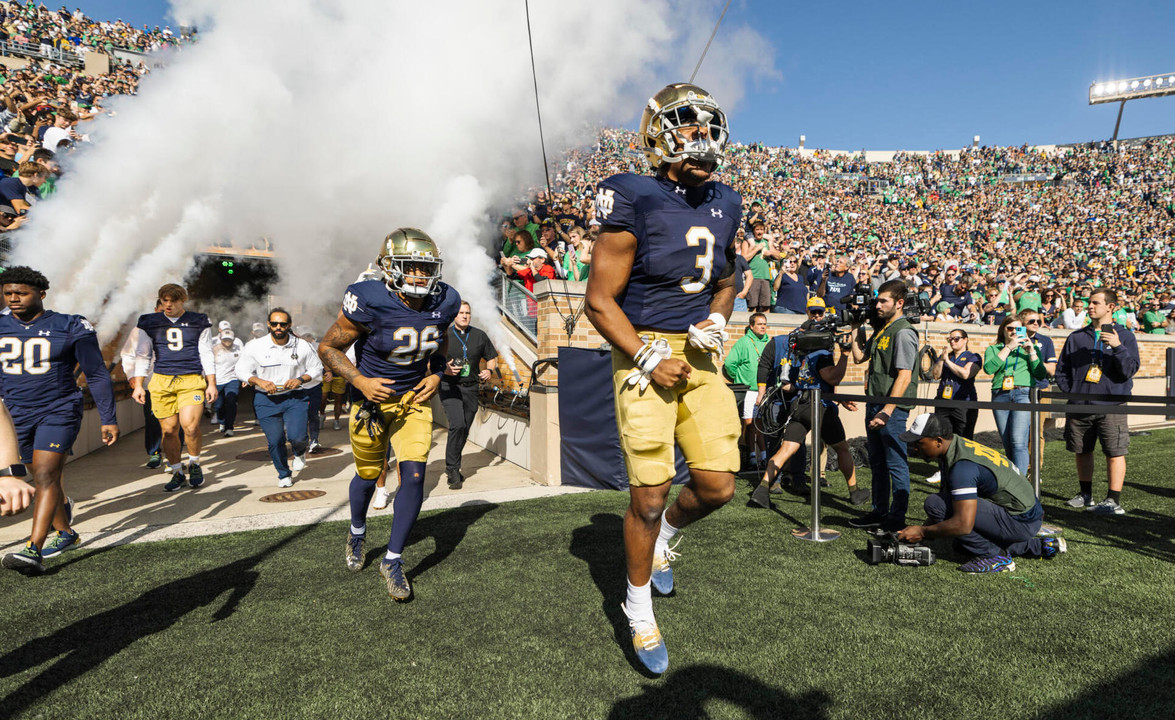
Before Michael Mayer had shattered more records and before Isaiah Foskey had again shown the promise of a high-level NFL Draft pick and before Logan Diggs had shouldered his heaviest load since his prep days at Archbishop Rummel in Boutte, Louisiana, Notre Dame had made a 7-letter vow as its season rested on its line of demarcation.
U. R. G. E. N. C. Y.
Neither any coach nor any player had found satisfaction in the Fighting Irish’s disappointing 3-3 start, particularly with the team’s play at home inside Notre Dame Stadium, and first-year coach Marcus Freeman settled on a singular resolve to begin to turn things around.
“It’s pretty much a mindset, urgency,” said veteran Notre Dame defensive back Clarence Lewis. “Even the little things, getting to places faster on time or coming up faster at the end of practice. Just having that extra sense of urgency like even in the little details.”
Added Foskey, who established the early tone in the Fighting Irish’s 44-21 win with a pair of blocked punts and relentless pressure on multiple UNLV quarterbacks, “
“The whole emphasis this last week was just urgency, like everything is right now,” said Foskey, who eschewed the 2022 NFL Draft for more moments at Notre Dame such as Saturday’s win and this week’s showcase-event against nationally ranked Syracuse. “That’s what we did.
“Everything was just right now, be intentional with it, start out fast, and that’s what we did.”
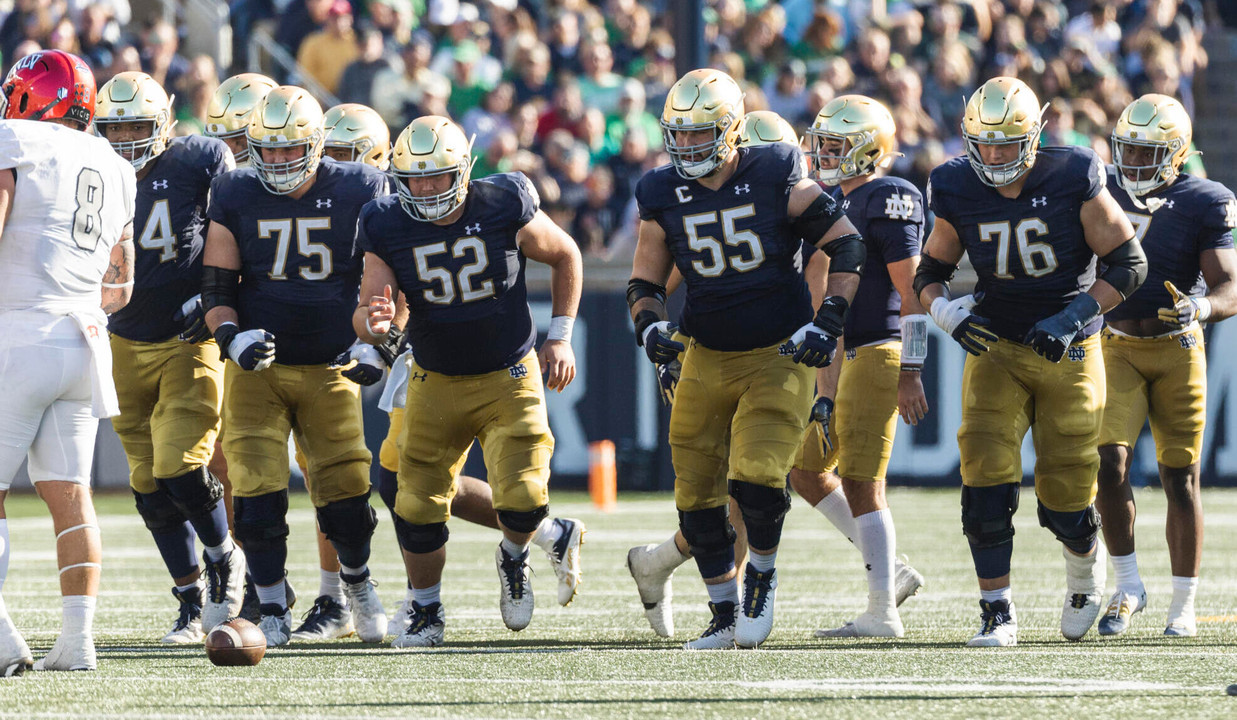
To be clear, nary an element of Notre Dame’s latest outing – its fourth win against three losses, two of them of the most disappointing variety at home – was perfect.
Even with a pair of blocked punts, which vaulted the Irish to four this season under first-year year special teams coordinator Brian Mason, there were a missed field goal and minimal kickoff-return yards.
Offensively, red-zone production wasn’t perfect; the two blocked punts resulted in 10 instead of 14 points; turnovers were given away by land and by air.
Defensively, the Irish limited the visiting Runnin’ Rebels to less than 300 yards’ offense (299), did not allow a third-down conversion, tallied nine tackles for losses and a quartet of quarterback hurries.
UNLV also orchestrated three touchdown-drives of 75, 75 and 76 yards that ranged from big-play fueled – a 74-yard sprint yielded a three-play touchdown march – to sustained execution.
“Listen, it wasn’t perfect,” said Freeman, who with his fourth win has the Irish within two victories of bowl eligibility. “We know that. That’s the reality of football. It’s never perfect. There’s a lot of things that you’re going to look and want to correct, but overall they played a really good game.
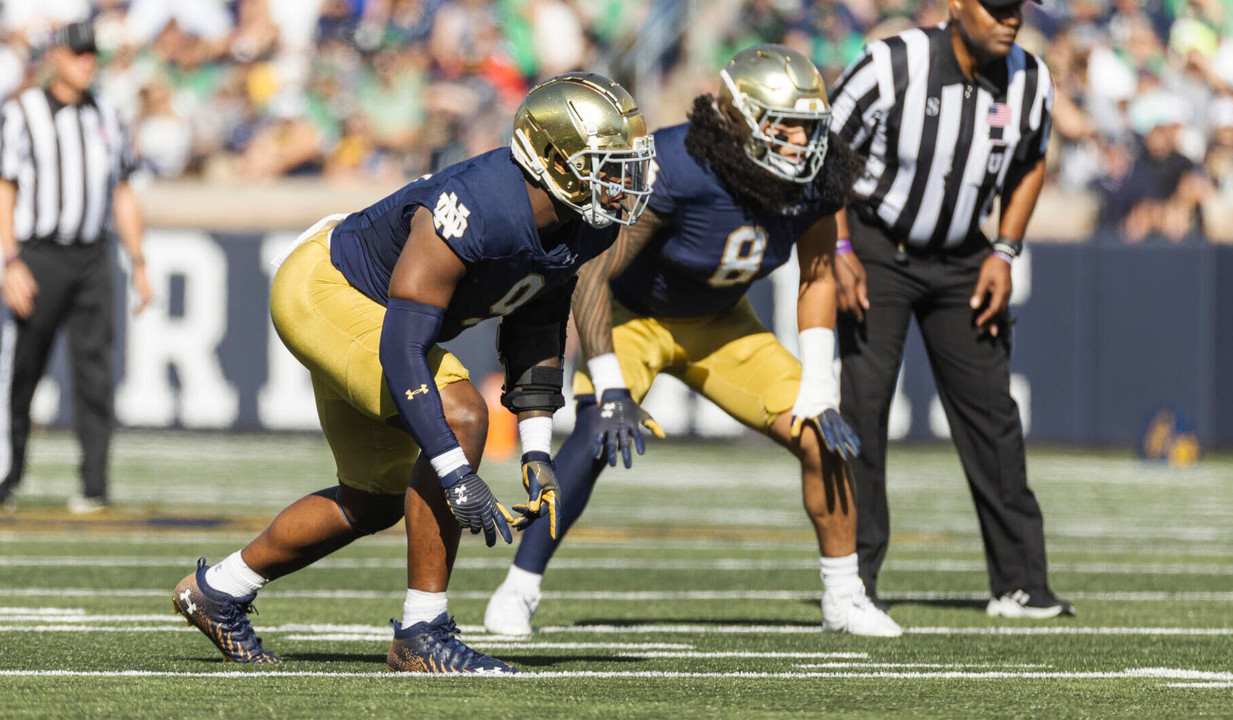
“To be able to — on all three phases — there was work to do on all three phases, but there was really big highs (Saturday) on all three phases, and that was good to see, from special teams to offense to defense. They all played at points really, really well, and they all played at points not so well that we have to improve.
“That’s the reality of football. That’s where we are as a team. We have to continue to get better, right? You’re talking about the ebbs and flows of a season to get us to this point where you see it in a game. You see it within series. For them to get a victory like this is really pleasing for them, for me, and for this program.”
In victory, and from a sophomore who has started but also not commanded his position until in this contest, the Fighting Irish also saw that urgency embraced for a chance to do more this season.
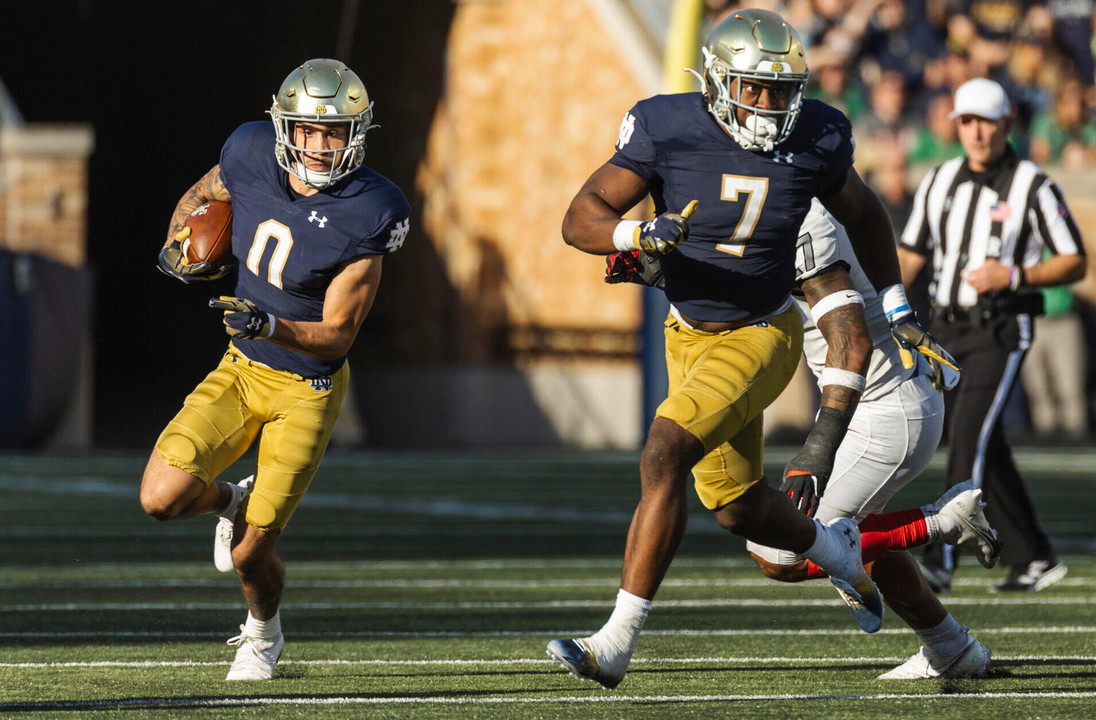
Logan Diggs, his 28 carries the most of his 14-game collegiate career, could have ducked a post-game question about his interactions with fellow sophomore tailback Audric Estimé, who helped clinch Notre Dame’s Shamrock Series win against BYU Oct. 8 but who also has of late proved to have some ball-security issues.
“All I can do is continue to be my brother’s keeper,” Diggs, who had 130 yards against UNLV, said of his approach to his teammate Estimè. “I tell him like, man, I feel that for you. And I told him, you know, I’ve been in that situation. The ball is the most important thing on the offense, and you can’t let that go.”
Diggs’ response to Estimè encapsulated the Irish urgency after a late fumble against Stanford rendered the team’s second home loss inevitable.
“So last week I was kind of on the side of it’s going to be all right; just keep on doing your job, keep being better,” Diggs said. “But (Saturday) I was a real teammate and told him, for real, if you want to play, you’ve got to hold onto the ball. It’s as simple as that. We have that mutual respect and that love.
“I could tell him anything, and he could tell me anything.”
The Irish now can tell one another they have improved enough to be a team with one more win than loss and likewise showcased enough, endured enough adversity and injury, that their margin for error has been laid bare.
Urgency, then, is the only course to salvage this season of transition.
“The ability to give yourself — to put yourself in position to win is really what we focus on,” Freeman said, “and that’s the plan, the preparation, but at the end of the day, we’re evaluated off of the result. We’re evaluated off of did we win or did we lose.
“We needed this. We needed this for our mentality, but our confidence to be able to just go — and we are a good team.”
With sustained urgency and ever-improved execution in all phases, the Irish just might continue to lend credence to their coach’s belief.